
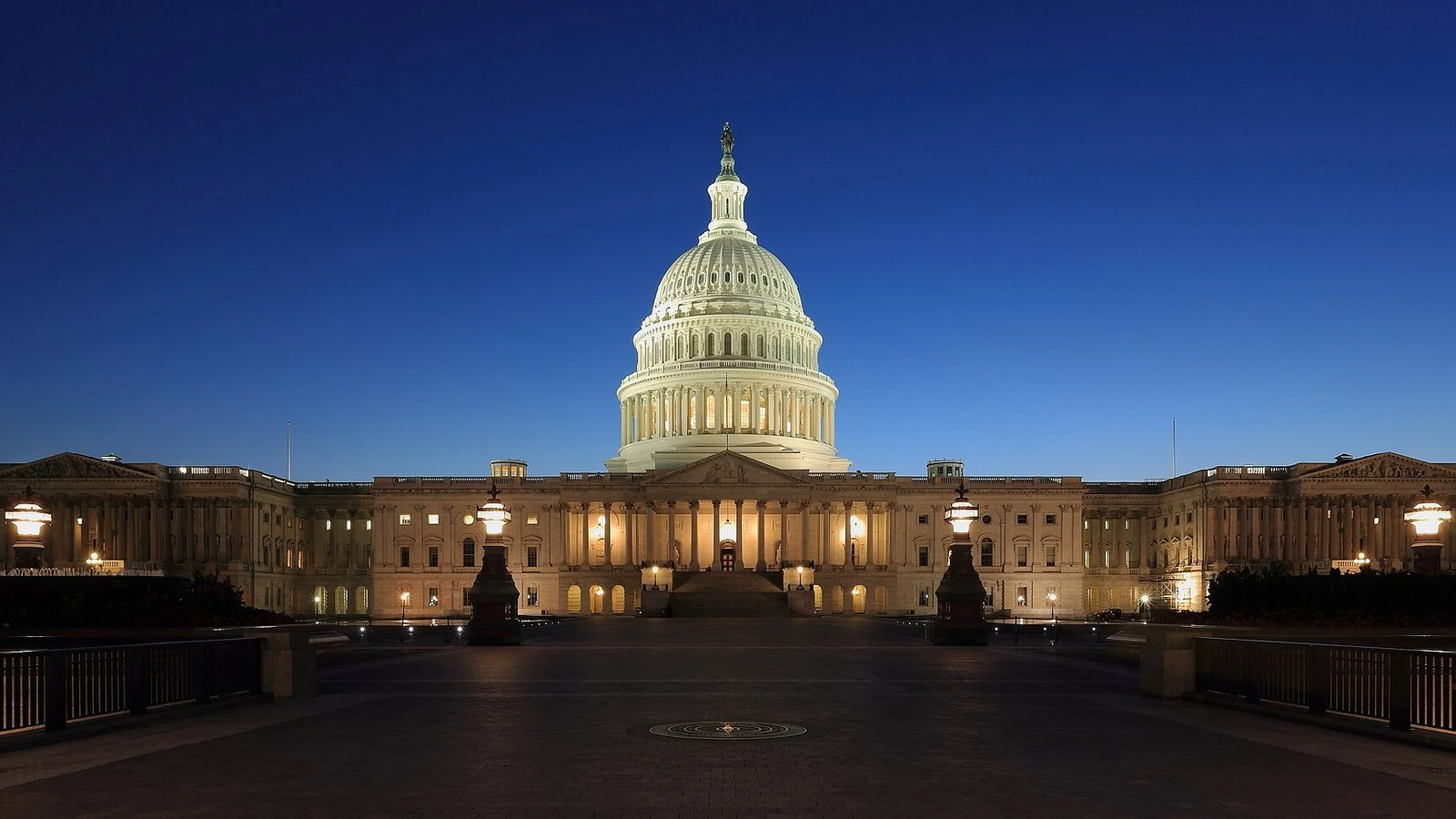
Tuesday night was not close. Democrats will control both the House and the Senate in January, and the first reaction in the bond market was a modest sigh of relief. For anyone who owns, finances or develops commercial property, the more useful question is what actually changes, and what doesn't.
The results, as of Wednesday afternoon
NBC News projected Democratic control of both chambers. As of its 4:10 p.m. ET update on Wednesday, the network showed 54 Senate seats for Democrats against 44 for Republicans, with Mississippi and Alaska still uncalled, and a net gain of seven seats. NPR's tally of Associated Press race calls listed the Senate flips as North Carolina, South Carolina, Ohio, Texas, Kansas, Iowa and Maine.
The House margin is larger still. NBC had 242 Democratic wins called against 146 for Republicans, a net gain of 35 seats so far, and its Decision Desk model estimates Democrats finish with about 258 seats. It is the first time since 2023 that Democrats control all of Congress, and it sets up two years of divided government with a Republican White House.
Gridlock is the base case, and markets like it
President Trump told the Pod Force One podcast before the vote that he would become "Mr. Veto" if Democrats took Congress, adding that "at some point we'll probably make deals." With a veto in one hand and two hostile chambers in the other, sweeping legislation in either direction becomes unlikely.
History backs the calm. In a note published Wednesday, Cushman & Wakefield found that private commercial real estate posted positive returns after 10 of the last 12 midterms. The NCREIF Property Index returned an average of 9.2% in the four quarters starting with the election quarter, close to the 8.7% average for all comparable periods since 1978. Average returns under unified and divided government were nearly identical, at 8.8% and 8.6%. The firm's conclusion: rates, growth and credit move property values far more than election outcomes do.
Where Congress still matters to CRE
Divided government is not the same as irrelevant government. Three pressure points deserve attention.
First, deadlines. According to RSM, federal government funding, surface transportation authority and the National Flood Insurance Program all expire on December 11. A lapse in flood insurance can stall closings and refinancings in flood zones where lenders require a policy.
Second, the debt limit. Cushman & Wakefield expects it to bind next spring, with Treasury potentially running short of cash about a year from now. In a bond market that has already pushed the 10-year yield to multi-decade highs this year, a standoff would add pressure through the term premium, which feeds straight into commercial mortgage pricing.
Third, trade and housing money. With legislation harder to pass, the administration may lean on tariffs and executive action. RSM notes that the Section 232 duties on steel, aluminum, copper and certain wood products survived February's Supreme Court ruling on emergency tariffs, and that tariff increases on kitchen cabinets and vanities are scheduled for January 1, 2027. On housing, the administration's fiscal 2027 budget proposes eliminating the CDBG and HOME programs, which many tax credit deals rely on for gap financing. A Democratic House makes those cuts far less likely.
State and local ballots carried their own weight
Some of the most direct property impacts came further down the ballot. Florida voters approved Amendment 3, a property tax overhaul that halves the cap on annual assessment increases for commercial and other non-homestead property (we cover it in detail in a separate article). In New York City, Commercial Observer reports that voters passed five Mamdani-backed charter proposals, including one that lets the city sell or lease smaller city-owned lots through an expedited review instead of the seven-month ULURP process, and another that routes construction permitting through the Department of Buildings as a single hub. Texas, meanwhile, elected a governor who campaigned on a data center moratorium.
What it means for CRE investors and owners
Do not underwrite a policy change that requires a signature from both parties. Tax law, including current treatment of depreciation, 1031 exchanges and carried interest, is more likely to stay put than to move in either direction over the next two years.
Watch the calendar instead of the headlines. If you have a closing or refinance on flood-zone property near December 11, confirm your lender's insurance requirements now and price private flood coverage as a backup.
Treat interest rates as the variable that matters. Cushman & Wakefield expects the 10-year Treasury to settle between 4.5% and 5.0% through 2027 and expects income growth, not cap rate compression, to drive returns. That argues for buying and operating assets where rents can grow, rather than waiting for falling rates to bail out a thin deal.
Read local results closely. In New York, faster permitting and land disposition could shorten timelines on certain projects. In Florida and Texas, ballot outcomes change tax and development math in ways that matter far more to a specific asset than who chairs a committee in Washington.
Sources
NBC News, Senate results: https://www.nbcnews.com/politics/2026-elections/senate-results
NBC News, House results: https://www.nbcnews.com/politics/2026-elections/house-results
NPR, Democrats win full control of Congress: https://www.npr.org/2026/11/03/g-s1-149526/2026-midterms-congress-balance-of-power
Cushman & Wakefield, U.S. Midterms 2026: Policy Impact on CRE: https://www.cushmanwakefield.com/en/united-states/insights/midterms-2026
RSM US, What the 2026 midterm elections could mean for construction and real estate: https://www.rsmus.com/insights/industries/real-estate/us-midterm-elections-2026-construction-real-estate
Commercial Observer, NYC ballot proposals passed: https://commercialobserver.com/2026/11/ballot-proposals-pass-nyc-mamdani-election/
Published by The Basis. Research dates, source references and illustrative assumptions are retained from the original article.