

The answer depends on the equity check, the closing conditions, and how much time is left.
An assumable 4% loan can make an apartment acquisition materially more attractive. But the rate alone cannot establish what a buyer should pay. The buyer is acquiring a property, taking over an existing debt balance, and funding everything the loan does not cover.
That distinction matters when a seller expects a premium for cheap debt. A lower payment can support that premium. A smaller loan balance, additional cash requirements, or a short remaining term can limit it.
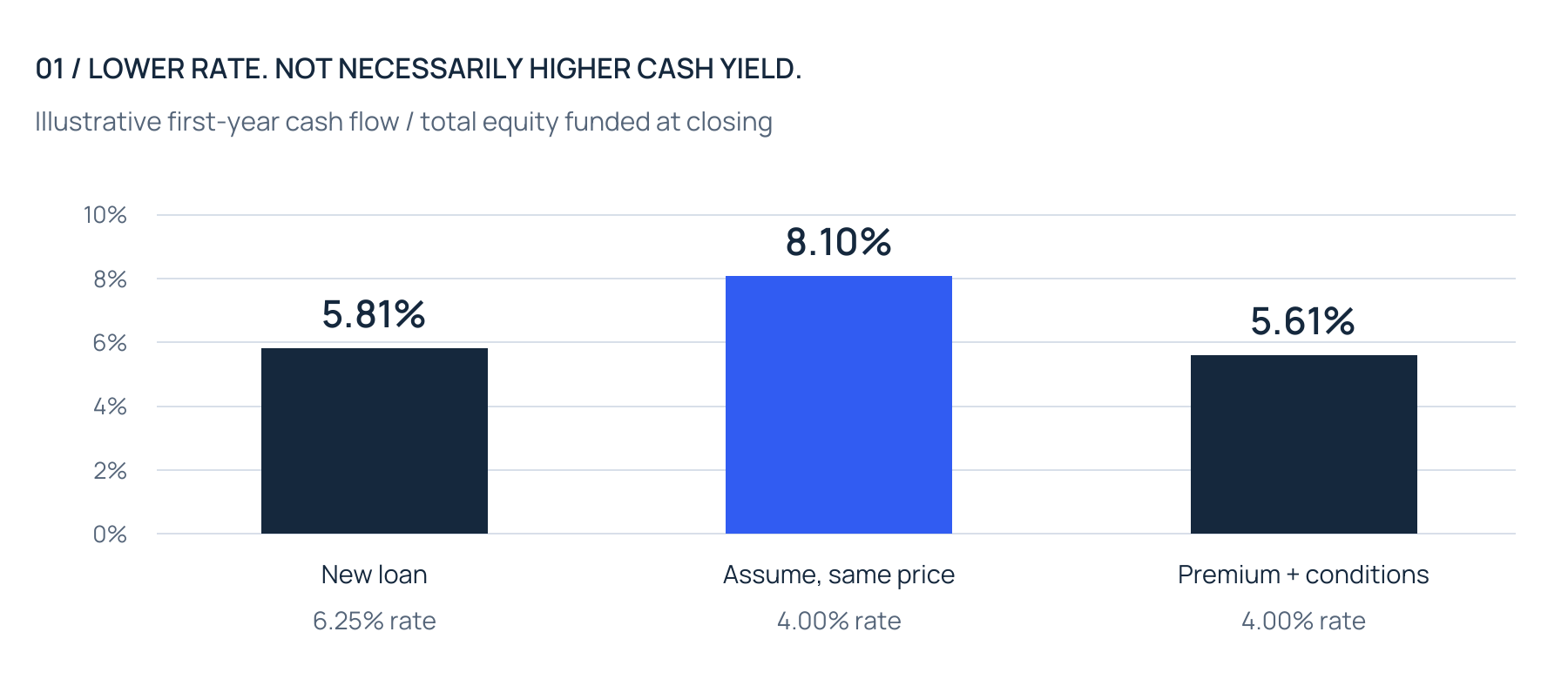
View chart data
| Financing scenario | Cash yield |
|---|---|
| New loan at 6.25% | 5.81% |
| Assume 4% debt, same price | 8.10% |
| Assume 4% debt, premium and conditions | 5.61% |
In the example above, the low-rate loan improves first-year cash yield at the same price. After a higher price, a paydown and a reserve requirement, the cash yield falls below the new-loan alternative. The coupon has not changed. The transaction has.
Start With The Equity Check
Price the whole transaction. Then compare the debt.
Hold annual net operating income at $1.50 million. Assume interest-only payments for the full comparison year. The third case tests a $4 million price premium, a $2 million reduction in the existing loan, and $1 million of additional restricted cash.
| Illustrative inputs / results | New loan | Assumption | Premium + conditions |
|---|---|---|---|
| Purchase price | $24.00m | $24.00m | $28.00m |
| Debt retained at closing | $16.00m | $12.00m | $10.00m |
| Interest rate | 6.25% | 4.00% | 4.00% |
| Upfront costs / capital | $0.60m | $0.60m | $0.60m |
| Additional restricted cash | $0 | $0 | $1.00m |
| Total equity funded | $8.60m | $12.60m | $19.60m |
| Annual debt service | $1.00m | $0.48m | $0.40m |
| NOI less debt service | $0.50m | $1.02m | $1.10m |
| First-year cash yield | 5.81% | 8.10% | 5.61% |
Source: Illustrative hypothetical model. Cash yield = (NOI - debt service) / total equity. No taxes, recurring capital spending, additional reserve deposits, reserve earnings or distributions, or other financing are modeled. Include them in live underwriting.
Count the paydown once. Equity equals price minus debt retained, plus costs and reserve funding. Reducing debt from $12 million to $10 million already increases the buyer's equity requirement by $2 million. Adding the paydown again would overstate cash needed.
Separate restricted cash from expense. A reserve can reduce distributable cash and tie up capital without being a permanent loss. Its release conditions and eventual use belong in the full investment model. The first-year ratio does not capture those later movements.
The third case is a sensitivity, not a claim that lenders routinely require these amounts. It also has less debt and therefore a different risk profile. A lower current cash yield alone does not prove it is the worse long-term investment.
What Can The Buyer Actually Pay?
Translate the financing advantage into a price constraint.
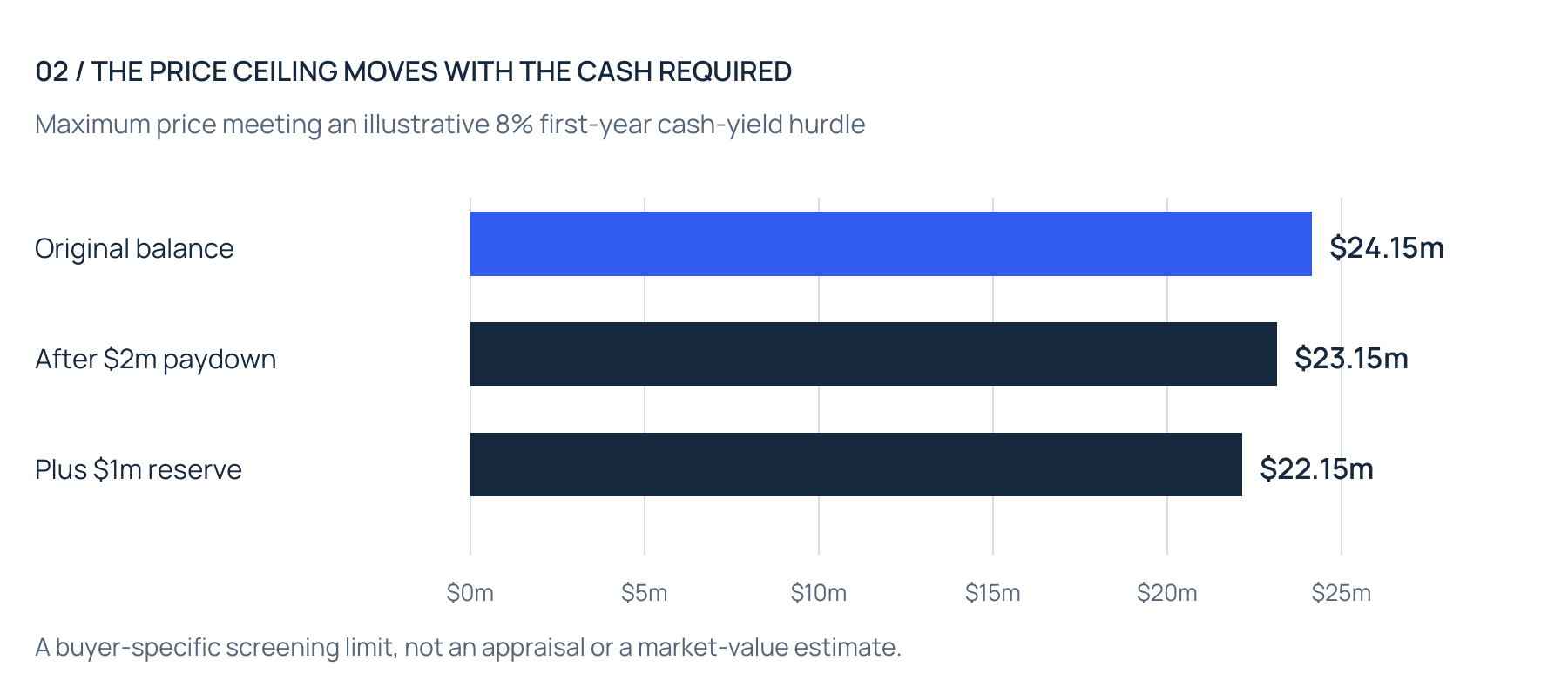
A useful first screen works backward from the buyer's required cash yield. At an illustrative 8% hurdle, $1.02 million of annual cash flow supports $12.75 million of initial equity. Add the $12 million loan and subtract $600,000 of upfront costs: the price ceiling is $24.15 million.
View chart data
| Scenario | Maximum price |
|---|---|
| Original balance | $24.15 million |
| After $2 million paydown | $23.15 million |
| Plus $1 million reserve | $22.15 million |
Screening formula: Maximum price = debt retained + annual cash flow / required cash yield - upfront costs - reserve funding.
The $2 million paydown saves $80,000 a year at 4%. At an 8% cash-yield hurdle, that extra cash flow supports only $1 million of additional equity. The other $1 million must come out of the price to preserve the hurdle. Funding another $1 million reserve reduces this first-year price ceiling by another $1 million.
This explains why a buyer can appreciate the loan and still resist the seller's price. Cheap debt is valuable, but replacing it with equity is not free. The outcome depends on the buyer's return requirements and liquidity, not just the interest-rate spread.
Do not fill the gap with an assumed supplemental loan. Fannie Mae's 2026 term sheet lists eligibility, loan-to-value and debt-coverage limits, a new appraisal requirement, and availability beginning 12 months after the senior loan closes. Any additional proceeds need their own approval and pricing; they do not automatically inherit the senior loan's rate. [2]
The Value Has An Expiration Date
Three years of savings is not a permanent income stream.
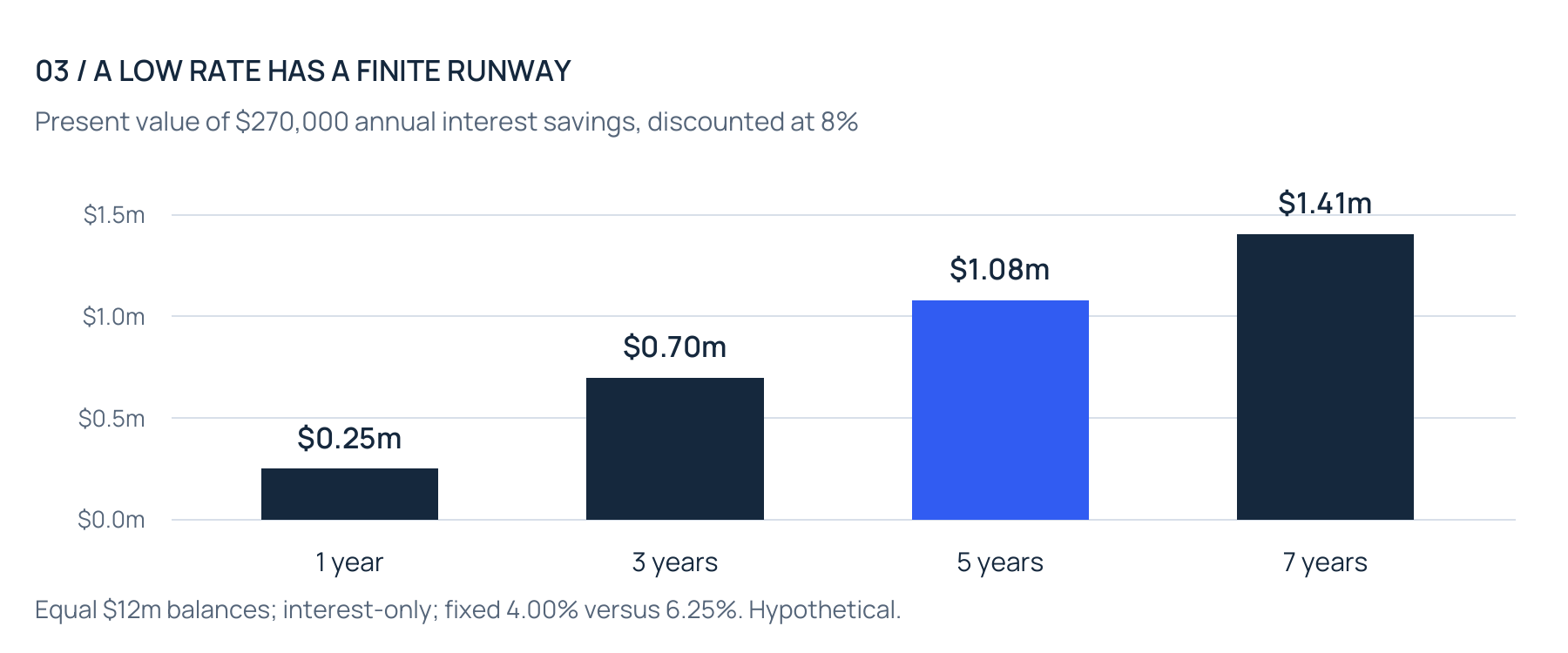
To isolate the rate advantage, hold both loan balances at $12 million. A 4% rate instead of 6.25% saves $270,000 a year on interest-only debt. Discount those annual savings at 8%, and three remaining years are worth roughly $696,000; seven are worth about $1.41 million.
View chart data
| Remaining years | Present value, rounded |
|---|---|
| 1 | $0.25 million |
| 3 | $0.70 million |
| 5 | $1.08 million |
| 7 | $1.41 million |
These figures isolate one benefit. They are not a complete loan valuation or a recommended purchase-price premium. A live comparison must also reflect different loan proceeds, fees, payment schedules, prepayment terms and refinancing dates. The equal-balance test here deliberately differs from the acquisition cases above.
The remaining interest-only period matters separately from maturity. On a hypothetical $12 million loan at 4%, annual interest-only debt service is $480,000. Switching to monthly payments on a fresh 30-year amortization schedule would increase annual debt service to approximately $687,000, even though the rate stays at 4%. Use the actual remaining schedule for the property.
Freddie Mac's published assumption guidance describes the transaction as a review of the new sponsor and collateral, rather than an opportunity to renegotiate the underlying loan. Do not assume a sale restarts the loan term or interest-only clock. Verify the note and approval terms. [1]
Before paying a premium, model the year interest-only ends and the year the loan matures. The financing benefit can run out before the buyer's business plan is complete.
From An Attractive Rate To An Executable Sale
Make the advantage verifiable.
For sellers, the strongest presentation is a clear loan package alongside the property's operating results. For buyers, the strongest offer explains which financing assumptions support the price and which conditions would change it.
1 / Establish the actual debt. Collect the current balance, rate, payment schedule, maturity, remaining interest-only period, prepayment provisions, existing reserves and all amendments. Distinguish original terms from what remains today.
2 / Verify the path to approval. Ask the servicer to identify the required borrower review, property review, fees, reports, potential cash conditions and decision process. Freddie Mac's guidance describes reviews of sponsor strength and experience, property performance and condition, with reserves among possible mitigants. [1]
3 / Match the buyer to the equity requirement. Confirm both acquisition equity and the liquidity needed to satisfy the review. Freddie Mac's submission guidance separately addresses guarantor liquidity verification, property financial analysis and closing documentation. A buyer's willingness to pay does not establish that the assumption can close. [3]
4 / Compare executable alternatives. Put the assumption and replacement financing on the same NOI, capital plan and hold period. Compare total cash required, annual distributions, principal repayment and exit proceeds. Include actual prepayment costs and who bears them. Resolve any extra debt before relying on it.
Investment perspective: A low-rate loan is most persuasive when the buyer can see the economics after approval conditions, rather than having to discover them during the transaction.
Does your financing strengthen your sale price?
Compare the property with its existing debt and with replacement financing, and identify which assumptions drive the buyer's price.
Sources & methods
[1] Freddie Mac Multifamily. Approach to Loan Assumption Requests. May 2021.
[2] Fannie Mae Multifamily. Supplemental Mortgage Loans term sheet. 2026.
[3] Freddie Mac Multifamily. Common Misses on Loan Assumption Submissions. March 2023.
Reviewed October 28, 2026; the historical Freddie Mac guidance remains linked on its resource page. Agency documents illustrate process requirements; they do not establish the terms of a particular loan. Confirm current requirements with the servicer. All financial examples are hypothetical and use no private transaction information. Models are analytical screens, not appraisals or forecasts.
Published by The Basis. Research dates, source references and illustrative assumptions are retained from the original article.